Let me begin with a question: Why is prayer so difficult?
Have you ever noticed that we never have to force ourselves to watch TV, scroll through our phones, or browse social media? But when we decide to pray, drowsiness sets in, the phone rings, we remember tasks, our minds wander…
Why? Because there is a spiritual battle. The devil does not care if you have a closed Bible on your shelf. He becomes concerned when you open that Bible on your knees.
The disciples themselves felt this difficulty. That is why, in Luke 11:1, they made one of the most important requests ever recorded: “Lord, teach us to pray.”
They did not ask, “Teach us to preach” or “to perform miracles.” They knew that without prayer, nothing works. If the disciples—who walked with Jesus—needed to learn to pray, how much more do we?
Illustration
Imagine a state-of-the-art smartphone. The best model, the best camera, the best processor. But with no battery. It still looks beautiful, but it does not work.
That is what a Christian without prayer is like. They may know the Bible, attend church, sing, and serve. But without prayer, they lose connection to the Source of power.
The greatest answer to prayer is not what God does for us, but what God does in us.
- FAILING TO PRAY IS THE SIN OF SELF-SUFFICIENCY
When we stop praying, we are saying with our actions: “I can manage on my own. God, I do not need You; I do not depend on You.”
This is what Samuel was speaking about: “Far be it from me that I should sin against the LORD by failing to pray for you.”
Every time we stop praying, we feed self-sufficiency.
Leonard Ravenhill said: “The praying believer stops sinning; the sinning believer stops praying.”
The less we pray, the more vulnerable we become. The lack of prayer opens the door to lies, grumbling, pornography, addictions, discontentment, disobedience, and rebellion.
What does prayer produce in our lives? It produces holiness, salvation, fruitfulness, faith, transparency, brokenness, humility, and protection. It shapes our character into the image of Jesus. And it is not just for ourselves: failing to intercede for our brothers and sisters and for our nation is also a sin of omission.
Pride says: “I can manage.”
Prayer says: “Without Me you can do nothing.” (John 15:5)
- THE NATURE OF MAN AND THE INNER BATTLE
To understand why prayer is so hard, we need to understand who we are.
“May God Himself, the God of peace, sanctify you through and through. May your whole spirit, soul and body be kept blameless.” — 1 Thessalonians 5:23 (NIV)
God created us as body, soul, and spirit. And this reality explains the battle within us.
“For the flesh desires what is contrary to the Spirit, and the Spirit what is contrary to the flesh. They are in conflict with each other.” — Galatians 5:17 (NIV)
When you were born again, your spirit—which was dead—was made alive, and the Holy Spirit came to dwell in you. But the flesh still resists. The decision to seek God takes place in the soul. That is where we choose whether to pray or not. That is why prayer demands a conscious decision every single day. The flesh will never want to pray; the soul must master the body and seek God.
- THE THREE LEVELS OF PRAYER: THE TABERNACLE
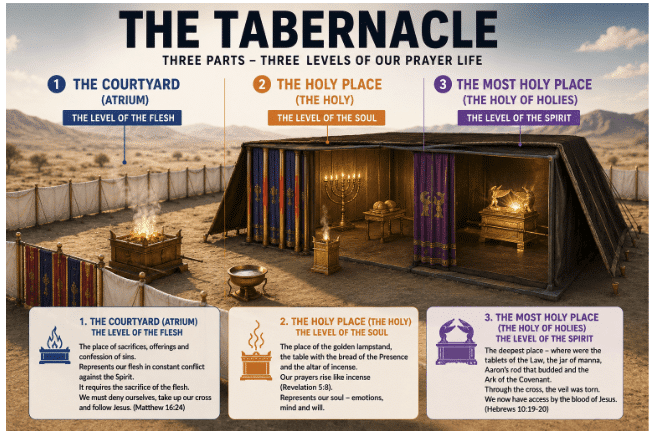
The Old Testament Tabernacle—with the Courtyard, the Holy Place, and the Most Holy Place—offers us a picture of our spiritual growth journey and our pursuit of deeper intimacy with God.
We are the temple of God (1 Corinthians 3:16). The Tabernacle had three parts—Courtyard, Holy Place, and Most Holy Place—which perfectly illustrate the levels of our prayer life.
THE COURTYARD — The Level of the Flesh
The courtyard was the place of sacrifices. Many Christians only pray in the courtyard: petitions, bargains—they only seek God when they need something.
The flesh will always resist prayer. It prefers comfort, distraction, screens, social media, and entertainment over the presence of God. The flesh feels sleepy, lazy, and tired when it is time to pray.
Jesus said: “Whoever wants to be my disciple must deny themselves and take up their cross and follow me.” (Matthew 16:24, NIV)
Taking up the cross means death to the flesh. The spirit is willing, but the flesh must be crucified daily.
THE HOLY PLACE — The Level of the Soul
In the Holy Place, prayers ascended like fragrant incense to God (Revelation 5:8). This level represents the soul—emotions, mind, and will. It is the place of praise, gratitude, and brokenness.
Crying and being moved emotionally in God’s presence is good, but it is not enough. Many Christians are “soulish”: they live by feelings. When motivated, they go to church. When a struggle arises, they give up. Their emotions govern their faith, and that is why they do not bear fruit, do not develop their calling, and do not make disciples.
We must command ourselves as David did: “Why, my soul, are you downcast? Put your hope in God, for yet I will praise Him.” (Psalm 42:5, NIV)
THE MOST HOLY PLACE — The Level of the Spirit
Here there is no hurry; there is presence. We do not seek only answers—we seek God Himself.
This was the most sacred place, where the Ark of the Covenant—the symbol of God’s presence—dwelt. In ancient times, only the high priest could enter, once a year. But at the cross, the veil was torn.
“Therefore, brothers and sisters, since we have confidence to enter the Most Holy Place by the blood of Jesus, by a new and living way opened for us through the curtain, that is, His body…” — Hebrews 10:19–20 (NIV)
Today any child of God may enter. Not because they deserve it, but because Christ opened the way. In the Most Holy Place, our spirit communes with God in deep intimacy. It is that moment when you enter your room and, before you say a single word, the presence is so real that tears flow. Silence, contemplation, delight. It is where we are transformed and where the supernatural manifests: healings, miracles, and deliverance.
“You make known to me the path of life; You will fill me with joy in Your presence.” — Psalm 16:11 (NIV)
The greatest enemy of prayer is not a lack of time. It is self-sufficiency.
Illustration
A newly married couple talks for hours—not because they have important matters to discuss, but because they love being together. Those who love God learn to delight in His presence. There comes a moment when you no longer pray only to receive something—you pray because you have found the greatest treasure: God Himself.
What level are you at? The Courtyard, the Holy Place, or the Most Holy Place?
- HOW TO BUILD A LIFE OF PRAYER
“The Spirit helps us in our weakness. We do not know what we ought to pray for…” — Romans 8:26 (NIV)
What a precious truth! The Holy Spirit dwells in you, and when you do not know what to say, He intercedes in you, for you, and through you. Do not wait to feel like praying before you start; begin to pray, and the desire will grow with perseverance. Discipline produces delight. No one starts out enjoying the gym, but those who persevere learn to like it. Prayer is the same.
Jesus asked: “Couldn’t you keep watch with Me for one hour?” (Matthew 26:40, NIV) If you do not have the habit yet, start with 15 minutes and build from there.
We have 12 hours of prayer every first Saturday of the month – from 7am to 7:pm.
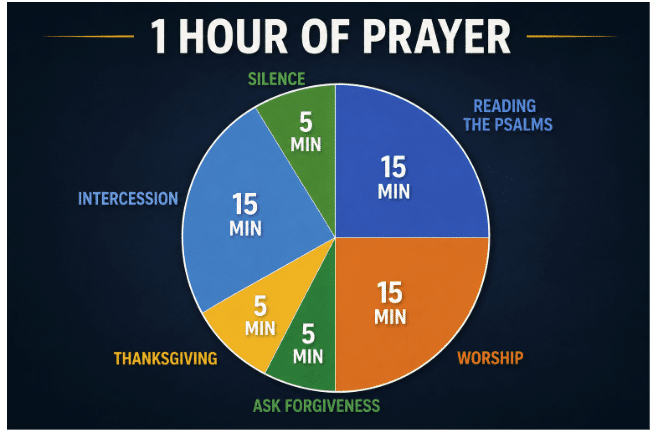
A Practical One-Hour Prayer Guide
00–15 min — Overcome the flesh by reading and declaring the Psalms. This drives away distractions: bills, work, tiredness. The best time is in the morning, as Jesus did.
15–30 min — Praise and worship. Exalt the sovereignty of God.
30–35 min — Repentance and confession. Confess your sins by name, and also the sins of your family and nation.
35–40 min — Thanksgiving. Give thanks for life, health, salvation, provision. We have more than enough reasons.
40–55 min — Intercession. Pray for authorities, the church, the sick, the lost. Use the Word as a spiritual sword.
55–60 min — Silence and listening. Be still and hear what God wants to speak to your heart. In prayer, we speak; in the Most Holy Place, we also listen.
CONCLUSION
We live in a generation connected to everything, yet disconnected from God. We have time for series, social media, news—but we cannot find minutes to talk to the Father.
The greatest tragedy is not a church without resources. It is a church without prayer.
John Wesley said: “God does nothing except in response to prayer.”
The question is not: “Do you believe in prayer?” The question is: How is your prayer life?
Pride says: “I can manage.”
Prayer says: “Without Me you can do nothing.” (John 15:5, NIV)
Prayer does not only change circumstances; it first changes the one who is praying.
APPEAL
Today God is calling people to a deeper level. Perhaps you are still in the courtyard. Perhaps your soul still governs your faith. God is saying: “Come closer.”
Jesus has already opened the way. The veil has already been torn. The Father is waiting.
Do not wait for a crisis to learn how to pray. Begin today. Abandon self-sufficiency. Live in intimacy. Decide to set aside time for God every single day.
Because men and women who learn to live on their knees are raised up by God to stand firm in the face of any storm.